Bullying 

Bullying is very common among children and young people. It’s found in every culture and occurs wherever there are groups of people below a certain level of social skills development. Peak occurrences of bullying tend to occur around the age of fourteen.

Being bullied can be traumatic and affect a child’s developing self-worth, emotions and attitude to school. The long-term effects of bullying include higher levels of depression, loneliness, generalised and social anxiety. It can also decrease someone’s sense of self-worth. An interesting fact about bullying is that those who bully tend to have also been negatively impacted by it.

When children are bullied, they usually hide it from their parents or teachers. It can take some time before the important adults in their lives learn what is going on. It’s extremely important that everyone stays vigilant and attempts to take a preventative approach to prevent children from bullying and experience being bullied. Most schools in Australia are engaged in this process and have implemented a “no tolerance” to bullying policy.

Types of bullying

Bullying is a specific form of aggression. It involves an imbalance of power where one person repeatedly and intentionally causes harm to someone else (who is generally in a weaker position of power).

Bullying is very different to conflict. ‘Power’ and ‘time’ are two factors that differentiate the two. When a person (or group of people) bullies, they typically hold more power, either physically or socially, over the person experiencing the bullying. Additionally, bullying happens repeatedly, over a period and is not one occurrence of harm.

Bullying is a behaviour that’s intended to cause or threaten harm (either emotional or physical) to another person. It can range from verbal teasing to using physical acts of violence. Here are some of the different types of bullying that people may experience.

Verbal: Verbal bullying is typically comprised of teasing, insults and put downs, name calling, and spreading gossip about another person or group of people.

Social: Social bullying involves shunning, isolating someone from their peers, cutting them out of a group or turning against them.

Mental: Mental bullying is when someone uses mind-games, gaslighting or blaming techniques to get their victim in trouble.

Physical: Physical bullying looks like pinching, hitting, restraining someone, throwing things, tripping someone up, purposely knocking into or bumping/shoving someone.

Extortion: Extortion may involve demanding someone to hand over their money, or lunches/ snacks. Bullies may also force their victim to steal something for them.

Gesture: This type of bullying includes making facial expressions or using body language/ non-verbal signs or signals to hurt or upset another person.

Racial: Racial bullying is any bullying that focuses on another person/ group’s racial or cultural background.

Gender and sexual: This involves gender-based or sexual based harassment. It can involve comments about another person’s body, “slut-shaming” or homophobia.

Phone: Phone bullying can occur when someone harasses another person through phone calls, text messages, sexting or using Apps such as Snapchat, Instagram, WhatsApp.

Internet: Internet, or cyber bullying, is any bullying that occurs online, such as via social media, forums or email.

Causes of bullying

There are many reasons why people bully. Bullying can be viewed as a maladaptive or adaptive behaviour.

The maladaptive theory explains that for children who bully, they tend to experience difficult home lives. For instance, they experience or have experienced aggression, corporal punishment or even family violence. Children can learn aggressive behaviours to solve problems, usually after witnessing adults in their lives doing the same thing.

The adaptive theory explains that people bully to exhibit superior strengths and resources. Bullies believe that by behaving in a certain way, they can gain further power and social standing.

Some children bully others to gain popularity, particularly when they see other (apparently) powerful children succeeding in this way. These children may already feel bad about themselves and want to feel more powerful. Sometimes, they might bully another child to fit in.

Children who are sensitive, shy, cautious and quiet tend to be bullied more than others. They may react to bullying in ways which reward the bully, such as crying, shutting down or giving in. Bullies then become used to getting what they want and continue to bully others.

There’s no one factor that puts any child more at risk of experiencing bullying or bullying others. Bullying can happen anywhere for any number of reasons.

Effects of bullying

Some common immediate effects of being bullied include:

  • Embarrassment
  • Shame (which is why some children hide it from their parents)
  • Low self-esteem, self-worth, and/or self-acceptance
  • Anxiety
  • Stomach pains, headaches
  • Sleep problems, such as difficulty sleeping or nightmares
  • Wetting the bed
  • Refusing to go to school.

The longer-term effects of bullying can cause greater issues. Bullying that is continuous and hidden can have disastrous consequences for a person, continuing into adulthood. Those who have experienced bullying over longer stretches of time may exhibit:

  • Difficulty expressing emotions
  • Difficulty verbalising thoughts and feelings
  • Social anxiety, generalised anxiety
  • Difficulty forming relationships with others
  • Very limited support networks or social isolation
  • Fear of rejection, or not being accepted
  • A sense of hopelessness, or helplessness
  • Depression and suicidal thoughts.

Early signs that your child is being bullied

Children deal with their experiences with bullying differently. However, there may be some signs that your child might be experiencing bullying, including:

  • Shyness around other children
  • Difficulty expressing thoughts
  • Low self-esteem
  • Appearing anxious, fearful, distressed
  • Trying to avoid situations where other children will be present
  • Refusing to go to school
  • Frequent complaints of illness: headaches, tummy aches
  • Isolation, not seeming to have many close friends, spending a lot of time in their room
  • Increased risk-taking.

How to respond to your child

The first step is to create an atmosphere where your child can feel like they can come to you about anything. Let them know you’re always open to hearing what they tell you and won’t get upset. You should also let them know that you won’t act without talking to them first. Children often worry that their parents might do something that will make the situation worse.

Here are some tips for responding to your child, when they feel ready to talk:

  • Listen to them and be present
  • Don’t jump straight into problem solving mode
  • Validate their thoughts and feelings and reflect what they might be feeling back to them
  • Ensure they feel heard and understood by you
  • Let your child know that you want to help. They should know they don’t have to feel alone. Tell your child that they are not alone, and many children experience bullying. The fact that they are being bullied does not mean anything about them as a person and it’s not their fault.

What you can do

Once you have the full story and your child feels unburdened and less alone, you can act. It’s important to act quickly and not assume that the situation will go away on its own. When you act quickly, you’re setting an example that bullying is never acceptable.

Work with your child to brainstorm some ideas and solutions. You can create a plan together. If your plan involves direct action on your behalf, make sure that your child knows about this and can provide you with feedback.

Once you have a plan, ensure you talk to all responsible adults who are in charge and have a role in the situation. Arrange meetings with teachers or the other parents. Discuss anti-bullying policies in the school and what can be done. When consulting with the other adults in the situation, make sure that the children (bullies and the victim) are spoken to separately.

How to help your child manage bullying

Here are some ways that you can help your child if they are experiencing bullying:

  • Listen openly and show them that you are listening
  • If you feel your own strong reactions, keep them quiet. Stay calm
  • Assure the child that the bullying is not their fault
  • Ask what your child did that made them feel better or safer. Positively reinforce even tiny actions that your child took, as this was all they knew to do
  • Tell your child that bullying is a problem, and it needs to be stopped
  • Ask your child about their opinion about how they think the problem of bullying might be solved
  • Offer suggestions. If your child is being bullied, they could:
    • Tell the bully to stop in a calm clear voice, using assertiveness skills
    • Try to laugh it off, which may catch the bully off guard
    • If these options aren’t safe, walk away. Find an adult to help you.
  • Choose a solution from all the options and help your child to try it out. Use role playing
  • Practice the solution and then talk about how it went. Keep practising
  • Praise your child for coping.

What works to stop bullying?

There’s been a lot of research into strategies that schools, organisations and parents can implement to stop bullying. Different approaches show varying degrees of success. The main concept to keep in mind is that bullying only takes place when the benefits outweigh the consequences. Programs such as “zero-tolerance” ask bullies to give up an advantageous behaviour without gaining anything in return — not a recipe for likely success.

Typical responses are social skills training and anger management. These have varying degrees of success but are worthwhile. Two factors have been shown to be reduce bullying. They include training parents to support their children, and disciplining / providing consequences for bullying behaviours.

Since bullying can be difficult to detect, particularly by adults, it makes disciplining this behaviour problematic. Increased efforts in identifying bullying, when it occurs, is likely to be helpful. When bullying has immediate consequences, it reduces the benefits and likelihood or re-occurrence. Therefore, increasing parental awareness of, and intolerance toward bullying can be very effective. Encourage your children’s school to send literature out to all parents, advising them what to look out for. Include some educational resources in effective discipline strategies.

Educating students on the benefits of defending victims, rather than being “bully bystanders,” has also proven very helpful.

Bullies can also be shown that pro-social strategies can be used, as an alternative to coercive strategies, to attain social standing. Using a problem-solving skills training framework can help with this. For instance, using strength and athleticism to defend a victim from a bully is a good way to display attractive qualities to each other. Doing favours for people will increase not only the child’s popularity, but the likelihood of reciprocation from their peers later.

The key to this approach is focusing on the child’s social goal of attaining popularity or social power. We’d be using a problem-solving approach to help them attain that goal. By doing this we are highlighting alternative, helpful and healthy strategies that achieve the desired benefits with far fewer costs than bullying.

If you need more support

If you’re concerned that certain behaviours in your home life are causing your child to act in an undesirable way or cause physical, psychological or emotional harm to others – please reach out. Our Family Counselling Services support families and children to navigate challenges stemming from challenging home lives.

Additionally, we offer a range of Children and Parenting programs, such as School Readiness and Child Social and Emotional Wellbeing Programs to help children and their parents to navigate bullying and the emotional impacts it can have on them. To learn more about our programs, or to get in touch with our team, please call 1300 114 397.

Youth worker sitting on a park bench with young female client.
  • Home
  • Queensland Mental Health Week 2024

Queensland Mental Health Week 2024

Queensland Mental Health Week runs from 07 to 15 October, coinciding with World Mental Health Day (10 October). It’s a week to recognise the importance of individual and community mental health and wellbeing 

Each year, one-in-five people will experience a mental health concern. Queensland Mental Health Week encourages us to raise awareness and understanding of mental health issues within our communities to reduce the negative stigma associated with mental health. 

The theme for this year’s Queensland Mental Health Week is ‘Awareness, Belonging, Connection.’ It aims to raise awareness around mental ill-health, stay connected to others and support meaningful conversations. 

How to maintain good mental health and wellbeing

Many things can impact mental health and wellbeing, and there are many ways to improve or maintain it. Here are some helpful self care tips for mental health. 

  1. Improve your physical health. 
    Frequent exercise and a healthy diet can increase your energy levels, concentration and help you think more clearly.  
  2. Get out amongst nature.
    Science has proven that when people spend time in nature, they’re less likely to experience negative feelings such as anger and stress. Genetically, humans are programmed to be soothed by nature. 
  3. Take time to focus on the present.
    When you feel busy or overwhelmed, it’s important to pause and take notice of the present. Mindfulness techniques can help you to relax and increase your awareness of your surroundings and mind. 
  4. Show kindness to yourself and others.
    When you do something kind for someone else, you’re likely to experience increased happiness. Kindness also has a dual benefit of making others feel better, too.  
  5. Connect with others. 
    Leaning in on the social support of others can help reduce feelings of stress and loneliness. You can connect with others by talking to people you trust, volunteering, helping people and talking to those who may be going through similar experiences to you.  

Here are some other self care tips for mental health and wellbeing: 

  • Improve your sleep 
  • Engage in learning opportunities 
  • Track gratitude and personal achievements in a journal 
  • Do things you enjoy or take up new hobbies 
  • Set goals. 

Seeking professional support

One of the best things that you can do when you are experiencing mental distress is to seek counselling services or talk to someone. If you’re noticing symptoms that are constant, persisting for two weeks or more, or affecting your daily life in a negative way – it’s recommended that you seek professional help. There’s never a wrong time to seek assistance for your mental health. 

If you require emergency support, please call 000 or Lifeline on 13 11 14. Lifeline is a free crisis and emergency support service that’s available 24/7.  

Alternatively, if you require less urgent assistance, you may wish to seek assistance from a GP, who can point you in the direction of professional mental health services and provide you with access to referral partners.  

Our counselling services

Anglicare Southern Queensland supports the physical, emotional and spiritual needs of Queenslander’s. We provide counselling services for individuals, families, couples and children. To learn more about them, please click here. 

If you are concerned about the mental health of someone you know, read our recent article about R U OK? Day, which provide some tips on how to check in with someone and start a conversation. 

  • Home
  • Unhelpful thinking patterns

Unhelpful thinking patterns

Everyone has different thinking patterns. Often, we don’t stop to think about our thoughts and whether they’re accurate, appropriate or helpful. Some of the ways that we think about things can be unhelpful (whether they’re accurate or not).

What you think about something tends to be based on emotion rather than facts. This is an example of what is often an unhelpful thinking pattern.  

For instance, you could make an error at work and when your manager brings it to your attention you might feel embarrassed or ashamed and ask yourself “how could I be so stupid.” By thinking like this, you might start to feel worse about yourself causing you to wake up the next morning and realising how stressed and tired you are. You then might think to yourself. “I don’t ordinarily make that mistake. I think I was tired and not at my best when I did that.” 

It’s not uncommon for your frame of mind to change and the way you perceive an event.  

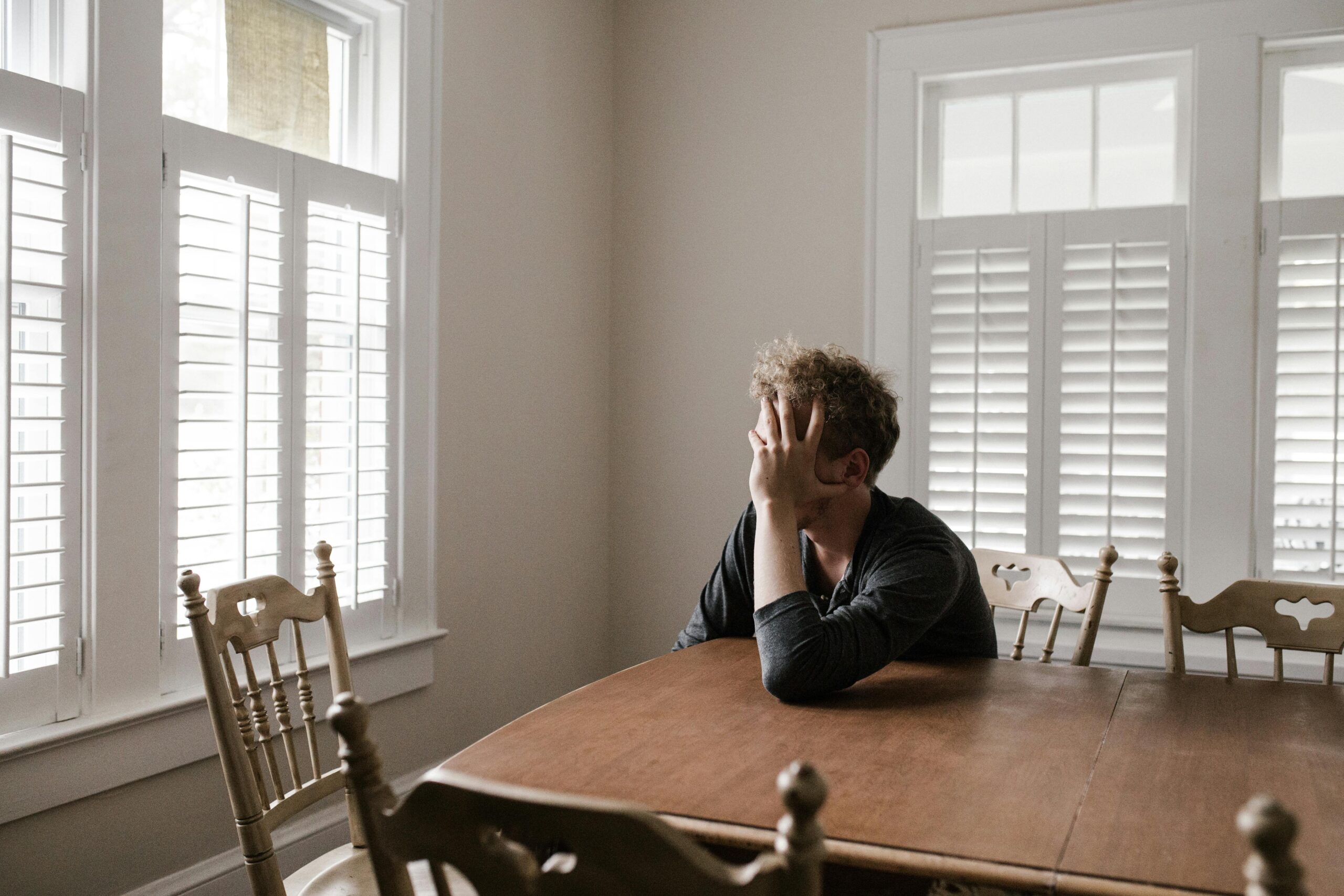
Unhelpful thinking patterns. Man sitting at table looking overwhelmed and staring out his window

Thoughts lead to feelings 

Events and situations don’t make you feel anything. However, the way you think about them, and the feelings associated with those thoughts do. 

Thoughts, judgements, beliefs and interpretations are factors that contribute to feelings. People can interpret matters in several ways. If you notice that you’re feeling upset, consider looking carefully at how you’re thinking about a situation and try to interpret it differently. 

Unhelpful thinking patterns 

If you’re having thoughts that cause you to feel worse about a situation, this is an unhelpful thinking pattern. When you notice yourself feeling negatively about something, it can be useful to take a step back from your thoughts, to look at them and ask yourself whether it’s true or helpful. Then try to consider a more helpful way of thinking about the situation. 

Sometimes it doesn’t matter if the thing that you’re thinking about is true or not. It’s important to consider whether it’s helpful for you to focus your time and energy on it. If it’s only going to make you feel worse, why focus on it? Instead, consider focusing on something that will make you feel better. 

Below are some examples of unhelpful thinking patterns. These patterns will make you feel worse about a situation and are feelings-based, not fact-based. If you notice yourself getting upset because of some of these patterns, take a step back and try to change your thought patterns. 

Demanding 

Demanding thoughts are often categorised by words such as ‘should’ or ‘must.’ As humans, a common mistake we make when thinking is that we or things ‘should’ or ‘must’ be a certain way. This way of thinking is not flexible and can leave people prone to distress in situations where the demand isn’t met. 

Awfulising 

This is the tendency to exaggerate the negative consequences of a situation. An example of how this looks like is: “if I don’t pass my driving test it will be the end of the world!”   

This kind of thinking inflates a problem until it seems impossible to deal with. 

‘Should’ thoughts are like awfulising thoughts as they tend to cause people to think things should be a certain way because it would be awful if they weren’t. 

Take a step back from this thought and put it in perspective. 

All-or-nothing reasoning  

Also known as black-or-white reasoning, this thought pattern causes people to see a situation as either one way or the other. It can distort facts and cause people not to recognise that most situations are neither disastrous nor fantastic and that there can be an in-between. 

Generalisation 

When a person over-generalises, they draw conclusions about the world, others, or themselves, based on very limited evidence. You can identify this error of thinking (most of the time) when a person complains about a situation with words like ‘always’, ‘never’, and ‘everybody.’ It can often sound like an exaggeration. 

Taking it personally 

When a person feels responsible for something that’s not their fault, or when they incorrectly assume that another person’s response is directed at them, this is called ‘personalising.’ It’s important to resist the temptation to take matters personally. Doing so promotes better relationships and avoids stress. 

Selective attention (and selective memory) 

Negative ideas shape the way that a person perceives things. There’s only so much that we can focus on at one time. Therefore, if we’re always focusing on the negative, it doesn’t leave much room for us to consider positive events that happen. Selective attention is where a person selectively ignores the positive. 

Jumping to negative conclusions 

This error in thinking is the tendency to leap to conclusions that are negative, rather than waiting for the evidence. It results in assuming the worst of others, the world and ourselves, making it difficult for people to stick with things over time. 

Reading minds 

Mind reading is a specific sort of ‘jumping to negative conclusions’ based on the idea that we know what other people are thinking. Much of the time, this sort of assumption is wrong. This is quite common with social anxiety and social phobia. 

Labelling 

Labelling things is the ultimate generalisation. This is a way of branding people (or situations) as being characterised by a very limited set of qualities, when usually this is not the case. 

Condemnation (damning) 

This is a type of labelling, where you brand people or situations with a tone of condemnation during times of disappointment. It’s a thinking error because it usually results in bitter resentment and disempowerment. It causes people to feel exhausted. 

Predicting catastrophe 

This style of thinking causes people to wonder ‘what if’ about situations and to then focus on the negative outcomes that could happen. People don’t usually realise that matters can’t be predicted so easily in advance. 

Making false comparisons 

When people compare themselves to others, they gauge their own status, worth or success. It can cause them to evaluate themselves poorly. Comparisons aren’t fair and don’t consider all aspects of the situation or the support or luck that the person they’re comparing themselves to had along the way. 

Still need help? 

Anglicare Southern Queensland provides a range of social and community services to support the varying needs of Queenslanders. Our programs are designed to support the mental health and wellbeing of people at all stages of life. If you are experiencing unhelpful thinking patterns please click here to find out more about our service offerings. 

 
  • Home
  • Self care in stressful situations

Self care in stressful situations


Stress is a feeling or state of mental tension caused by stressful situations that might often feel like too much to bear. When we’re stressed, we may feel overwhelmed and challenged by circumstances. Stress is caused by anything, or anyone, who could pose a threat or challenge to our wellbeing or that of our loved ones. No one is immune to feelings of stress. It’s a natural response that the body experiences occassionally.

Is it good or bad to experience stressful situations? 

Stress, in moderation, can be a motivating factor for us to grow and achieve new things in life. Good stress is temporary and prepares us for action. 

Signs and symptoms of stress 

When we’re experiencing stress or stressful situations, our bodies release two major types of hormones; adrenaline and hydrocortisone. These hormones help us to switch off certain functions of the body, like the immune system. In turn, the body switches on other short-term energy reserves.  

When we feel threatened or psychologically aroused, our brains are wired to respond to challenges in the form of fight, flight or freeze (depending on the individual and their circumstances).  

When we feel stressed, we may experience: 

  • An increase in our heart rate 
  • Tight muscles 
  • A sense of alertness and danger 
  • Sleep disturbances 
  • Fast breathing 
  • Increased blood pressure 
  • Debilitation of the immune system 
  • Digestive problems 
  • Memory loss 
  • Fatigue 
  • Headache 
  • Poor concentration 
  • Difficulty making sense of things or compiling thoughts 
  • Changes to our rate of speech. 

Read more about stress here. 

Stressful situation: two women staring out over sunset at beach to relax themselves

When does stress become unhealthy? 

The way we respond to stress can impact our health and wellbeing. Depending on how we respond to and deal with it, it could build up destructive behaviour patterns and promote negative thinking. Stress can also create unhealthy habits, depending on how it’s managed. 

When stress interferes with our mental, psychological and physical health – to the point of not being able to function adequately, think properly or cope well, we increase our risk of facing a high stress situation. 

When our stress levels are constantly high and unmanaged, we may increase our risk of developing mental health conditions (including chronic fatigue, anxiety, panic attacks or post-traumatic stress disorder).  

How to deal with stress and stressful situations

One of the best cures for any condition is prevention. Thus, it’s important to be aware of our own triggers that may cause us to feel stressed. Importantly, we should learn to manage our triggers and practice effective self-care strategies. 

Self-care 

Self-care consists of strategies or activities that we can implement to improve our health, prevent hardships, manage existing conditions and boost our general wellbeing and self-esteem. 

What does self-care look like? 

Self-care starts by finding the balance between: 

  • Acknowledging the importance of valuing and respecting ourselves, establishing healthy boundaries, celebrating achievements, and building up our self-esteem; and 
  • Knowing our limitations, setting realistic expectations, accepting ourselves for who we are, avoiding putting ourselves down and comparing ourselves with others, because each one of us is unique. 

Self-care in times of stress and stressful situations

Depending on the situation(s) you might be facing, it could be useful to start implementing some of these self-care strategies: 

  • Recognising and becoming aware of your reactions to stress 
  • Assessing the situation, prioritising tasks and setting realistic goals. Remember, sometimes it is okay to say “no” to others 
  • If the challenging situation is a matter of life or death, act immediately and contact an appropriate service, e.g. Police, ambulance or Lifeline 
  • Aim to deepen and slow down your breathing (if appropriate and time permits it). Breathe in for four seconds, hold for four seconds and let go for four seconds 
  • Identify your own triggers, vulnerable areas and aim to defuse them or avoid them if possible 
  • Give yourself permission to be human and to feel someone else’s pain, and to develop that sense of empathy and care for others 
  • Choose useful and healthy responses to painful and difficult situations (e.g. avoid drinking alcohol when under stress 
  • Work towards addressing your own responses and your own personal issues instead of blaming or pointing the finger at others. Take responsibility for your emotions 
  • Choose your battles wisely. That is, accept the reality of life, especially those things that you’re not in control of and that you can’t change. Instead, invest your energy working towards factors that you can improve or change 
  • Avoid making big decisions if you feel confused and cannot think clearly. Don’t rush the process. It’s better to take your time to process and think things through more carefully 
  • Practice mindfulness, if appropriate and time permits, focusing on the present moment 
  • Aim to see the positive side of the circumstance and ‘think outside the box’ 
  • Allow yourself to take a break, especially in high stress situations 
  • Talk with people you trust or health professionals, to help you let go of held-in-thoughts and feelings, to build up that sense of connection and attachment with others, and to get their perspective 
  • Endeavour to keep healthy patterns of life such as eating healthy, exercising regularly and keeping a healthy routine to go to bed. 

What are you prepared to do to self-care? 

Write a list of things that you’re prepared to do and a list of things that you choose not to engage in when dealing with stressful situations. 

It’s not selfish to engage in self-care. To take care of others, it’s important to take care of ourselves. 

Still need help? 

For more information about our counselling services, please visit our counselling page. Our team provides support to individuals, groups, families and communities to improve their wellbeing and work towards achieving their goals. 

  • Home
  • Assertive communication

Assertive communication


Assertive communication (communicating calmly and rationally) is key to interacting smoothly with others, especially during instances of conflict or anger. Assertive communication can be difficult if you’re feeling angry. However, there are techniques to prepare yourself for when conflict arises.

Interpersonal conflicts arise when you feel that your rights have been violated. It helps to think back to a time before you started looking for ways to manage your anger; whenever you felt that someone showed you disrespect or violated your rights. During those instances, you might have responded with aggressive behaviour. 

However, there are other ways to resolve conflict without resorting to aggression. Negative consequences can result from aggression and it’s important to learn assertive communication skills. 

Aggressive, passive and assertive communication 

Aggression is behaviour that’s intended to cause harm or injury to another person or damage property. Aggression can include verbal abuse and non-verbal body language, threats or acts of violence. When someone has violated your rights, it’s not uncommon to want to fight back or retaliate.  

An alternative to reacting aggressively is to act passively. Passive communication is a non-assertive behaviour, which can also be undesirable. This is because people allow their rights to be violated while building resentment for the person who violated them. People who react passively to situations build anger within themselves, for not standing up for their rights, and this causes them to also become angry with the other person. 

Those who react passively tend to prioritise the feelings, thoughts and beliefs of others over their own. By acting passively or non-assertively, people tend to avoid the negative consequences associated with aggression, but this can lead to negative personal consequences like low self-esteem and unspoken resentment. 

What is assertive communication? 

From an anger management perspective, the best way to deal with a person who has violated your rights is to act assertively. Communicating assertively involves standing up for your rights in a way that’s respectful of yourself and of other people.  

When people react assertively, they respect the feelings, thoughts and beliefs of others as much as their own. By acting and communicating assertively, you can express your feelings, thoughts and beliefs to the person who violated you without suffering the negative consequences associated with aggression. You also avoid having your needs and feelings devalued. 

Assertive, aggressive and passive responses are all learned behaviours. 

Summary 

To conclude, aggression involves expressing feelings, thoughts and beliefs in harmful and disrespectful ways. Passivity or non-assertiveness involves failing to express feelings, thoughts and beliefs in an apologetic manner that others can easily disregard. Assertiveness involves standing up for your rights and expressing feelings, thoughts and beliefs in a direct, honest and appropriate manner which doesn’t violate the rights of others or show disrespect. 


  • Home
  • Anger control planning

Anger control planning


In this article, we’ll explore how to develop an anger control plan and how you can use certain strategies to control your anger. We’ll also cover other strategies, like learning to change negative or hostile self-talk and using the Conflict Resolution Model. These more advanced strategies can be used in addition to time out and other relaxation techniques. 

Developing an anger control plan

When developing an anger control plan, it’s ideal to test many strategies to find the best anger control technique(s) for you. Once you know what works for you, you can add these strategies to your anger control plan and use them when you’re starting to feel angry. 

Some people refer to their anger control plans as their toolbox, and the specific strategies they use to control their anger as their tools. Again, it’s important to identify the specific anger control strategies that work best for you. These strategies should be put down in a formal anger control plan for referral when you encounter an anger-provoking event. 

An effective strategy that many people use is to talk about their feelings with a supportive friend who was not involved with the event that made them angry. By discussing anger, you can begin to identify the primary emotions that underlie it and determine whether your style of thinking and expectations, in response to the anger-provoking event, are rational. Often, a friend that you trust can provide a different perspective on what’s going on in your life. Even if your friend just listens, expressing your feelings to them can often make you feel better. 

The long-term objective of anger management treatment is to develop a set of strategies that you can use appropriately for specific anger-provoking events. Later in this blog, we will provide strategies and techniques that are helpful in managing anger. Once you’ve selected the strategies that work best, you should refine them by applying them in real-life situations. To use the toolbox analogy, different tools may be needed for different situations. We’ll return to this concept in later sessions and highlight the importance of developing an anger control plan that helps you manage anger effectively in a variety of situations. 

Exercise is a great method for anger control planning

Time out 

As mentioned, previously, the concept of time out is important in anger management. It’s a basic anger management strategy that should be included in everyone’s anger management plan. Informally, time out is defined as leaving the situation that’s causing the escalation of anger or simply stopping the discussion that’s provoking it. 

Formally, time out involves relationships with other people. It involves an agreement or a prearranged plan. These relationships may involve family members, friends, and co-workers. Any of the parties involved may call a time out in accordance with rules that have been agreed on by everyone in advance. The person calling the time out can leave the situation, if necessary. It’s usually agreed, however, that he or she will return to either finish the discussion or postpone it, depending on whether all those involved feel they can successfully resolve the issue. 

Time outs are important because they can be effective in the heat of the moment. Even if your anger is quickly escalating on the anger meter, you can prevent it from reaching a 10 by taking time out and leaving the situation. 

Time outs are also effective when they’re used with other strategies. For example, you can take time out and go for a walk. You can also take time out and call a trusted friend or family member or write in your journal. These other strategies should help you calm down during the time out period. 

Can you think of specific strategies that you might use to control your anger? 

Should these strategies be included in your anger control plan? 

Relaxation through breathing 

We’ve discussed the physical cues to anger, such as an increased heartbeat, feeling hot or flushed, or muscle tension. These physical cues are examples of the stress response. The stress response causes the nervous system to feel energised and in this agitated state, a person is likely to have trouble returning to lower levels on the anger meter. In this state, additional anger-provoking situations and events are likely to cause a further escalation of anger. 

An interesting aspect about the nervous system is that everyone has a relaxation response that counteracts the stress response. It’s physically impossible to be both agitated and relaxed at the same time. If you can relax successfully, you can counteract the stress or anger response. 

We’ll end this session by practising a deep-breathing exercise as a relaxation technique. Later, we’ll practice progressive muscle relaxation as a secondary type of relaxation technique. 

Breathing exercise 

Try to get comfortable in a chair and close your eyes. Take a few moments to settle yourself and then make yourself aware of your body. Check your body for tension, beginning with your feet, and make your way to your head. Notice any tension you might have in your legs, your stomach, your hands and arms, your shoulders, your neck, and your face. Try to let go of the tension you are feeling. 

Now, make yourself aware of your breathing. Pay attention to your breath as it enters and leaves your body. This can be very relaxing. 

Take a deep breath in. Notice your lungs and chest expanding. Slowly begin to exhale through your nose. Be aware of what it feels like to breathe — attend to all the sensations. Again, take a deep breath. Breathe into your abdomen — place your hand on your belly and feel it rise with the breath. Push it down to your abdomen from your lungs. Hold it for a second. Now release it and slowly exhale. One more time, inhale slowly and fully. Hold it for a second, and release. 

Continue breathing in this way for another couple of minutes. Continue to focus your attention on your breathing. If you notice your mind wandering (and it will), just bring your attention back to your breath. With each inhalation and exhalation, feel your body becoming more and more relaxed. Use your breathing to wash away any remaining tension. 

Practice breathing for a minute or two in silence. 

Now, let’s take another deep breath. Inhale fully, hold it for a second, and release. Inhale again, hold, and release. Continue to be aware of your breath as it fills your lungs. Once more, inhale fully, hold it for a second, and release. 

Awareness

When you’re done, open your eyes. 

How was that? Did you notice any new sensations while you were breathing? How do you feel now? 

This breathing exercise can be shortened to just three deep inhalations and exhalations. Even that much can be effective in helping you relax when your anger is escalating. You can practice this at home, at work, on the bus, while waiting for an appointment, or even while walking. The key to making deep breathing an effective relaxation technique is to practice it frequently and to apply it in a variety of situations. 

Progressive muscle relaxation exercise 

Part 1

Already, we’ve practised deep breathing as a relaxation technique. Now we’ll introduce progressive muscle relaxation. Start by getting comfortable in your chair. Close your eyes if you like. Take a moment to really settle in. Now, as you did last time, begin to focus on your breathing. Take a deep breath. Hold it for a second. Now exhale fully and completely. Again, take a deep breath. Fill your lungs and chest. Now release and exhale slowly. Again, one more time, inhale slowly, hold, and release. 

Now, while you continue to breathe, deeply and fully, bring your awareness to your hands. Clench your fists very tightly. Hold that tension. Now relax your fists, letting your fingers unfold and letting your hands completely relax. Again, clench your fists tightly. Hold and release the tension. Imagine all the tension being released from your hands down to your fingertips. Notice the difference between the tension and complete relaxation. 

Now bring your awareness to your arms. Curl your arms as if you are doing a bicep curl. Tense your fists, forearms, and biceps. Hold the tension and release it. Let the tension in your arms unfold and your hands float back to your thighs. Feel the tension drain out of your arms. Again, curl your arms to tighten your biceps. Notice the tension, hold, and release. Let the tension flow out of your arms. Replace it with deep muscle relaxation. 

Now raise your shoulders toward your ears. Really tense your shoulders. Hold them up for a second. Gently drop your shoulders and release all the tension. Again, lift your shoulders, hold the tension, and release. Let the tension flow from your shoulders all the way down your arms to your fingers. Notice how different your muscles feel when they are relaxed. 

Part 2

Now bring your awareness to your neck and face. Tense all those muscles by making a face. Tense your neck, jaw, and forehead. Hold the tension, and release. Let the muscles of your neck and jaw relax. Relax all the lines in your forehead. One final time, tense all the muscles in your neck and face, hold, and release. Be aware of your muscles relaxing at the top of your head and around your eyes. Let your eyes relax in their sockets, almost as if they were sinking into the back of your head. Relax your jaw and your throat. Relax all the muscles around your ears. Feel all the tension in your neck muscles release. 

Now just sit for a few moments. Scan your body for any tension and release it. Notice how your body feels when your muscles are completely relaxed. 

When you’re ready, open your eyes. How was that? Did you notice any new sensations? How does your body feel now? How about your state of mind? Do you notice any difference now from when you started? 

Still need help? 

If you think you could benefit from some counselling or support, Anglicare Southern Queensland provides a range of programs and services to assist in this area. Our Living Without Violence service is a behaviour change program for men who use violence and abuse against their partners, children or other family members and helps them to create safety, respect and partnership in their current or future relationships.

  • Home
  • Bonding with your child

Bonding with your child

Bonding with your child is one of the most valuable gifts you can give to them. Positive attention helps to communicate that they’re valuable to you and it can be achieved through simple acts like smiling, encouraging them to talk or sitting down and playing their favourite game with them.
 

Why is it important to bond with my child? 

When you spend time with your child, you can help them feel loved and promote their self-confidence. For children, connection with their parents will help promote their sense of belonging and building positive identity and sense of self. 

Relationship building is an important factor of human wellbeing. Thus, treating your child with kindness and respect will help teach your child how to have healthy relationships as they grow. 

Building a strong bond with your child will give them a sense of safety and security. That means when they go through hard times, they’ll feel comfortable talking to you about their concerns. 

Talking about feelings 

Talk with your child about how they’re feeling. Ask them how they feel about certain experiences. Ask them what made them feel that way. Children will feel listened to, and their experience validated, which is a big part of bonding with your child. It will also help them to make sense of their feelings. 

Together, you can explore ways they can deal with their feelings. If they’re feeling angry, you might suggest going and jumping on the trampoline or kicking a ball together. Maybe they might like to listen to some music, draw or read a book with you. 

Talking with your child about their feelings and helping them find ways to express their feelings in a healthy way, will help your child learn valuable skills that will serve them well for their entire life and give them a sense of mastery. 

Above all, your children should feel loved by you. Even at times when you feel disappointed by their behaviours, you should ensure they feel loved and accepted. 

Bonding with your child: family playing football in backyard

The importance of play 

Play is a child’s way of learning or trying out different ideas and understanding their experience. However, most of all – it’s fun. Playing is one of the easiest bonding experiences you can have with your child. Play can help your child to: 

  • Relax and unwind 
  • Release positive creative energy and have some control and sense of mastery in their lives 
  • Express their ideas and understanding of themselves and the world around them 
  • Help them to make sense of their experiences 
  • Try out different ideas 
  • Build their capacity for creativity and imagination, which helps to provide a foundation for their problem-solving skills 
  • Learn how to interact with others and build their expressive language skills. 

Playing with my child — where do I start? 

Playing with your child doesn’t need to cost money nor needs to be difficult. The main aim for playing with your child is to have fun and enjoy each other’s company. It will give you a chance to relax, be creative, use your imagination and give you the opportunity to strengthen your relationship. 

Playing with your child can be as simple as saying yes to playing one of their games, offering to kick a ball outside, playing with Play-Doh, drawing or baking a cake. The list is endless. 

You could also suggest doing something that you both like to do together, like playing with a remote-control car, fishing, riding a bike, building a sandcastle or more. They’ll enjoy your company and might even gain an appreciation of your interests. 

Above all, enjoy each other. Laugh, be silly and have fun. 

For more children and parenting support 

To learn more about our children and parenting programs or family support services, please visit our Family and Wellbeing page on our website. Our caring and compassionate staff support the emotional wellbeing of families as well as the development and growth of children.   


  • Home
  • The aggression cycle

The aggression cycle


In our previous Anger Management and Anger Control Planning articles, we reviewed the anger meter, cues to anger and the anger control plan. In this article, we’ll present the aggression cycle to understand how to integrate the previously explored anger management concepts into practice.
 

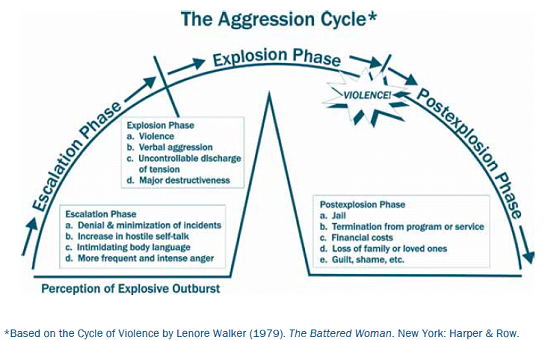
There are three phases of an anger episode: 

  1. Escalation 
  2. Explosion 
  3. Post-Explosion. 

      Together, they make up the aggression cycle. 

      Escalation 

      The escalation phase involves cues that indicate anger is building. As stated in introduction to anger management, these cues can be physical, behavioural, emotional, or cognitive (thoughts). 

      Cues are warning signs or responses to anger-provoking events. These events are situations that can occur daily and may lead to the escalation of anger if effective anger management strategies are not used early on. 

      Red-flag events are situations unique to you. They can be triggered or influenced by past events. These events can involve internal processes (thinking about situations that provoked anger in the past) or external processes (present anger provoking situations). 

      Explosion 

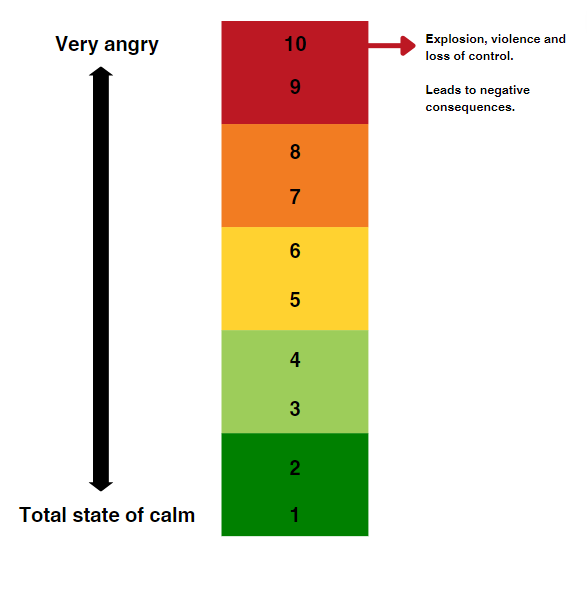
      If the escalation phase goes unmanaged, the explosion phase will follow. The explosion phase is marked by an uncontrollable display of anger; verbal or physical aggression. This display of anger can lead to negative consequences. This is equivalent to the number 10 on the ‘anger meter.’ 

      The anger meter is presented below. It’s a scale (or thermometer) ranging from 1 – 10, where 1 is calm and 10 correlates to explosive anger. It’s important to recognise if you are reaching anger levels of four or five (the escalation phase) and establish strategies to prevent your score from going any higher. 

      Post explosion 

      The final stage of the aggression cycle is the post-explosion phase. It consists of the negative consequences of the verbal or physical aggression displayed during the explosion phase. 

      These consequences may include feelings of guilt, shame and regret, losing family and loved ones, being terminated from a job, or going to jail. 

      What it may look like 

      The intensity, frequency and duration of anger in the aggression cycle varies among individuals. For example, one person’s anger may escalate rapidly after a provocative event and, within just a few minutes, reach the explosion phase. Another person’s anger may escalate slowly but steadily over several hours before reaching the explosion phase. Similarly, one person may experience more episodes of anger and progress through the aggression cycle more often than the other. However, both individuals, despite differences in how quickly their anger escalates and how frequently they experience anger, will undergo all three phases of the aggression cycle. 

      The intensity of anger also may differ. One person may engage in more violent behaviour in the explosion phase than others. For example, he or she may use weapons or assault someone. Another person may express their anger during the explosion phase by shouting at, or threatening, other people. Regardless of these individual differences, the explosion phase is equivalent to losing control and becoming verbally or physically aggressive. 

      Notice that the escalation and explosion phases of the aggression cycle correspond to the levels on the anger meter. The points below 10 on the anger meter represent the escalation phase – the ‘building up’ of anger. 

      The explosion phase, on the other hand, corresponds to 10 on the anger meter. 10 on the anger meter is the point at which one loses control and expresses anger through verbal or physical aggression that leads to negative consequences. 

      Not reaching the explosion phase

      One of the primary objectives of anger management treatment is to keep yourself from reaching the explosion phase. As mentioned, this is accomplished by using the anger meter to: 

      • Monitor changes in your anger 
      • Notice the cues or warning signs that indicate anger is escalating 
      • Use appropriate strategies from your anger control plan to stop the escalation of anger. 

      If the explosion phase is prevented from occurring, the post-explosion phase will not occur, and the aggression cycle will be broken. If you use your anger control plan effectively, your anger should ideally reach between a 1 and a 9 on the anger meter. This is a reasonable goal to aim for. By preventing the explosion phase (10), you’ll not experience the negative consequences of the post-explosion phase, and you’ll break the cycle of aggression. 

      Still need help? 

      Anglicare Southern Queensland provides advocacy, support and counselling programs for victims/survivors of domestic and family violence and targeted behaviour change and counselling programs for men who use domestic violence and abuse against family members. Access Anglicare Southern Queensland’s Family and Relationship Services or the Living Without Violence program, in Brisbane, if you think you would benefit from some counselling or support around this issue. 

      Other articles in this section 


      • Home
      • Core beliefs and self acceptance

      Core beliefs and self acceptance


      Core beliefs are strong beliefs that we hold about ourselves, others and the world we live in. They determine how we perceive and interpret our surroundings and play a role in our decision-making processes.
       

      When something happens to, or around, you, your mind will consult your core beliefs. This is a defence mechanism designed to protect you.  

      Core beliefs are very convincing – they’re full of persuasion and conviction. A core belief is something that you accept as true, and you don’t usually question it. Because your beliefs are so strong, you aren’t often aware of them. 

      Core beliefs are very important to a person. They determine the degree to which you see yourself as worthy, safe, competent, powerful and loved. Negative beliefs about yourself are harmful and can affect your level of self-acceptance and self-esteem. Your core beliefs significantly influence your sense of belonging and paint a picture of how you are perceived or treated by others. 

      Core beliefs as childish thinking patterns 

      Everyone has core beliefs which dictate our personal rules for how we live our lives in relation to others and the world around us. Core beliefs are formed during our early years and are based on thoughts about our experiences, the things we see people do, and the advice we’ve been given. 

      Core beliefs are formed in our early years and are therefore influenced by our child-like and adolescent thoughts. While there’s nothing wrong with adolescent thinking, they may lack insight and understanding that comes with greater life experiences.  

      For example, adolescent thinking can sometimes: 

      • Ignore the consequences of our actions 
      • Favour immediate gratification over long-term goals 
      • Rely on stereotypes or prejudices 
      • Be very self-centred, or “egocentric” 
      • Use emotive, subjective rationales rather than being objectively logical 
      • Perceive anger as strong and overvalue aggression to solve problems 
      • Lack practicality and flexibility (i.e. be less able to consider and integrate opposing or conflicting ideas). 

      This is why it’s important to acknowledge our core beliefs and try to consciously change them to a healthier, more adult-style of thinking. 

      Core beliefs and self-acceptance 

      Core beliefs directly impact the way we see the world and interpret consequences. They influence our judgement of others and ourselves. Core beliefs affect our self-esteem, self-worth and self-acceptance. 

      Core beliefs can be distorted by trauma, especially when a person is young. They’re often a response caused by hurt or rejection, causing a person to view themselves as flawed or unworthy.  

      Self acceptance: lady looking through mirror at herself

      A cycle of self-acceptance or self-rejection 

      When you constantly tell yourself that you’re not good enough, you’ll begin to focus on evidence that causes you to believe that it’s true. Thus, discounting any positive thoughts you may have. Understandably, this can cause you to feel worse over time because you’re convincing yourself it’s true. Once you reach this stage, it’s common to feel hopeless and unmotivated to attempt to change this. 

      On the other hand, if you remember the times you’ve succeeded, worked hard or connected with others, you’re convincing yourself that you are good enough. With this kind of thinking, you’re more likely to feel hopeful and motivated, and you give yourself more opportunities to disprove negative core beliefs. The more positive your beliefs are, the more they become confirmed and solidified by you. 

      Core beliefs make up your self-worth. They: 

      • Dictate what you can and cannot do (they are your rules); and 
      • Decide how you interpret the world (they are part of your self-talk). 

      Changing core beliefs takes a lot of time and effort – but it can be done. 

      What do core beliefs look like? 

      A core belief about yourself is centred around an “I” statement. For instance, “I am unlovable.” 

      A belief such as, “nobody loves me,” is a supporting belief; a prediction about what others will do (or have done) because of the core belief you hold. 

      If you say: “But it’s true! Nobody does love me!” It may be derived from the negative core belief that you haven’t been able to accept love and be loved. It may also be possible that the negative core belief helped others react the way they did, giving the appearance of the belief being true. 

      A core belief about others, or the world, takes the same format, but about the outside. For example, “People are…” or “The world is…” 

      Examples of core beliefs and supporting beliefs: 

      • Core belief: I am bad | Supporting belief: I can’t do anything right 
      • Core belief: I am smart | Supporting belief: I will succeed if I try 
      • Core belief: I am unlovable | Supporting belief: Nobody will ever appreciate me 
      • Core belief: People are untrustworthy | Supporting belief: People will take advantage and hurt me if they have a chance 
      • Core belief: I need to protect myself | Supporting belief: The world is not safe. 

      Identifying your core beliefs 

      You can find your core beliefs by using the Downward Arrow Technique. This involves following each thought down to the very core of where the underlying belief came from. 

      To begin, think about a common thought you have.  

      Example:  

      “I procrastinate too much.” 

      With this thought, ask yourself: “What does that mean about me?” 

      The answer should say something about you as a person, like “I’m lazy,” or “I’m scared I will fail.” 

      Ask yourself, again, “What does that mean about me?” 

      The answer might be, “I’m weak,” or “I am a failure.” 

      That might be your core belief, or you can ask again, “What does that mean about me?” 

      “I’m not good enough.” 

      Note: If you’re trying to determine your core belief about others, ask yourself: “What does that mean about people/friends/family?” or “What does that mean about the world?” 

      Once you’ve identified your core issue and one or more unbalanced beliefs, you can begin dialogue with your inner self that works with and protects you from the pain of those beliefs.  

      The first step is to learn to be aware of your thoughts. Once you recognise that you’re having automatic thoughts in response to your negative core beliefs, you can start to deal with the situation in an adult-style of thinking. 

      In turn, this helps you understand your core pain, your core issue and to understand the unbalanced beliefs you may have had about yourself. 

      Awareness of your thoughts 

      Many people take their thoughts for granted. We’re not taught to think about our thoughts – what they are, and how they differ from feelings. 

      Feelings are usually identified by one word which describes a sensation or a collection of sensations. For example: ashamed, anxious, guilty, sad, overjoyed, frustrated, furious, etc. 

      Thoughts are more complex and consist of many more words. They’re your self-talk and describe what’s running through your head. For example: “my partner is neglecting me.” 

      Some people experience their thoughts as a running commentary inside their heads. Others see them as printed words on a page. Sometimes thoughts take the form of images or moving pictures – like when we have a memory. Memories are a type of thought. 

      “Automatic thoughts” are the thoughts that pop up instinctively in response to something. For example, when someone cuts you off while you’re driving, an automatic thought might be, “what a jerk!” When you realise you’ve had that thought, you can challenge it, perhaps by thinking, “maybe they just didn’t see me indicating.” 

      The rules by which we live 

      Core beliefs are very subjective, meaning they can’t be easily tested or proven. However, we can test the rules that are derived from them. Core beliefs usually result in rules, thus, influencing how we live. Most rules are self-protecting – they’re designed to help us avoid pain, trouble and catastrophe. 

      If, for example, you believe that you’re a failure, your rules could include the following: 

      • Never try hard at anything 
      • Never ask questions or challenge the opinions of others 
      • Never expect to get ahead 
      • Never try out for a sports team 
      • Never quit a job. 

      You may believe that breaking one of these rules could lead to a catastrophe. For example, questioning if you tried hard and still failed. There would be no escaping direct confrontation with the negative core belief, being, “I am a failure.” 

      If you believe that you are unworthy, your rules might be to: 

      • Never ask for anything 
      • Always work extra hard 
      • Never say NO to anything 
      • Always strive to be perfect 
      • Never admit to a fault or mistake 
      • Never initiate contact with somebody you like. 

      According to adolescent thinking, living your life by these rules means you might just manage to avoid a confrontation with the core belief, “I am unworthy.” This type of self-protective rule protects you from feeling pain.  

      Unfortunately, living by these rules limits our opportunity to prove the core belief as incorrect. 

      Exercise: Identifying your rules 

      You can identify your own rules by completing this exercise: 

      Step 1: Write down your core belief on top of a piece of paper. 

      Step 2: Read the Basic Rules Checklist, below.

      Pick out some of the questions that seem relevant to you and ask them of yourself. Remember to be honest. 

      • How do I deal with other people’s: 

        • Anger
        • Needs, desires or requests
        • Disappointments or sadness
        • Withdrawal from you or rejection
        • Praise or support
        • Criticism

      • How do I deal with mistakes?
      • How do I handle stress, problems or losses?
      • How do I handle taking risks, trying new things and challenges?
      • How do I express my:

        • Needs
        • Feelings
        • Opinions
        • Anger
        • Pain
        • Hopes, wishes and dreams
        • Limits and saying no.

      • How do I ask for support and help?
      • How do I manage being:

        • Alone
        • With strangers
        • With friends
        • With family.

      • How am I at trusting others?
      • How do I make friends? Whom do I seek? How do I act?
      • How do I deal with children?
      • How do I manage my health or illness?
      • How am I at maintaining my self-care?

      Example: 

      Let’s say a core belief is “I am worthless.” Here are some supporting questions: 

      • How I deal with other people’s anger: 

        • I try to keep the peace 
        • I stay quiet or withdraw 

      • How I express my needs: 

        • I hint rather than ask directly 
        • I don’t ask for help, but sometimes get passive-aggressive when the other person doesn’t guess what I want 

      • How I express my opinions: 

        • I don’t disagree unless it’s someone I know well 

      • How I express anger: 

        • I keep it to myself 

      • How I deal with stress / problems / losses: 

        • I avoid making decisions 
        • I procrastinate taking action. 

      Step 3: Determine what catastrophes could happen if you were to break the rules. 

      Example: 

      From the list above, here are some potential catastrophes – things that might happen if I were to break the rule. 

      Rule  Catastrophic prediction 
      Keep the peace.  The other person will get angrier. It will be my fault. The relationship will end. 
      Don’t express needs directly.  I will be rejected. I will know my needs are unimportant. 
      Don’t disagree.  I will be wrong. Everyone will know I’m stupid. 
      Don’t express anger.  My feelings will be unacceptable. 
      Don’t make decisions or take action.  I will do the wrong thing or make matters worse. 

      So, now you’ve identified your core beliefs. 

      You’ve also figured out what rules your inner-self has made to protect you from facing that belief. 

      You’ve acknowledged the fears and catastrophes that these rules are designed to avoid. 

      So, what comes next? 

      Exercise: Changing core beliefs 

      YOU CAN CHANGE A CORE BELIEF 

      Step 1: First, choose a core belief that you want to change.

      Then focus on one of the rules that is dictated by that belief. Our plan is to consciously break that rule and measure the outcome.  

      Pick a rule that allows you to test the core belief directly. It’s also a good idea to choose a relatively low-fear rule to start off with. You want to warm up to this and not leap straight in. 

      The outcome of breaking the rule should be measurable. It should have a clear behavioural result, and a subjective feeling. You should also go pick one that you’re immediately able to observe the outcome. Don’t pick a long-term experiment as your first one. 

      Example: 

      “Don’t make decisions” would be a good one to test, because it’s the opposite of being powerless. It would be easy to see the outcome and feel any changes that result. 

      Step 2: Start a prediction log.

      In a notebook, write down your rule and what catastrophic outcome could occur by breaking it. 

      Example: 

      Rule: Don’t make decisions, don’t take action. 

      Experiment: When something goes wrong, create a step-by-step plan for how to solve the problem, and immediately take the first step. 

      Catastrophic outcome: I will do the wrong thing and make it much worse. I will regret my choice. Everyone will think I’m an idiot, and so will I. 

      Step 3: Script your new behaviour. Visualise what you will do. 

      Example: 

      If it involves communication, practice an imaginary test. Act it out with a support person, or alone in front of a mirror. You can even video yourself doing this. Then examine your voice and posture to ensure you’ve got it right. Sounding or looking cold, blaming, acting defensive or acting uncertain may just create undesirable outcome. 

      Step 4: Do the test. Try out your new behaviour, and collect data on the outcome.

      Write your results in the prediction log under a fourth heading. Then write your feelings and thoughts. 

      Example: 

      Actual outcome: I followed my steps and figured out the problem. The situation is resolved, perhaps not perfectly, but it was not idiotic. 

      Personal results: I feel proud, gratified and slightly more confident because I have accomplished this. I think I will be more motivated to take action again. 

      Step 5: Repeat the test for this rule. Come up with tests for other rules. Record your results. 

      Step 6: Rewrite your core belief in the form of an affirmation.

      If it’s a self-core belief, write in the first person. Keep it simple and short. Then come up with new recommendations to replace the old rules. 

      Example: 

      New core beliefs: I am capable. I am worthwhile. 

      Old rules  New responses 
      Keep the peace.  I can cope with conflict. 
      Don’t express needs directly.  My needs are as important as anyone else’s. 
      Don’t disagree.  I want to be the kind person who stands up for their beliefs. 
      Don’t express anger.  I can solve problems by expressing my anger in respectful ways. 
      Don’t make decisions or take action.  I have good judgment. I can solve problems. 

      Why is this important? 

      If someone pointed at your hair, claimed it was grass, and then started to laugh out loud at how silly you looked, would you feel hurt? 

      Probably not. 

      When you don’t believe you look foolish, you are not affected by what others think. Being aware that their mental image of you is not you gives you immunity to their opinion. 

      Our counselling services 

      Anglicare Southern Queensland provides a range of individual and family counselling support. Our services aim to improve the mental health and wellbeing of clients through increasing their dignity and social justice through self-determination and connection with community support. Click here for more information on our individual counselling services. 


      • Home
      • What is happiness? 

      What is happiness? 

      Happiness can mean different things to many different people and cultures. Broadly speaking, it can be best defined as how people feel in the present and how satisfied they feel with their lives (long-term contentment). Signs that might indicate you’re happy include: 

      • feeling fulfilled and content with your life 

      • enjoying positive and healthy relationships with others 

      • feeling accomplished and satisfied 

      • feeling positive more than negative 

      • being open to new ideas and experiences 

      • you can successfully practice self-care and treat yourself with kindness and compassion 

      • experiencing gratitude 

      • you want to share your happiness and joy with other people. 

      How to be happier 

      There are several habits and routines that you can incorporate into your daily life to become a happier person. Everyone experiences happiness differently, so it’s important to find strategies that work for you.  

      Below are some tips that may help you feel happier

      Exercise 

      Regular exercise can help reduce negative feelings and increase happiness in individuals as it releases mood elevating chemicals into your brain. Exercise also helps to improve your mental and physical wellbeing in other ways such as helping to improve sleep, energy levels and social connection.  

      Get plenty of sleep 

      Sleep is important for improving general health, emotional health and brain function. Adults should try to get seven to eight hours of sleep every night.

      Enjoy a healthy, balanced diet 

      Certain foods are known to affect/ improve your state of mind as they release chemicals into your brain to make you feel better. They include carbohydrates, lean meat, poultry, legumes, dairy and omega-3 fatty acids.

      Other habits 

      • Practice gratitude 

      • Compliment and show kindness to others and, importantly, yourself 

      • Acknowledge happy and positive moments in your life 

      • Declutter your personal space 

      • Spend time with people who boost your mental wellbeing 

      • Spend more time in nature 

      • Meditate 

      • Consider taking up therapy 

      • Volunteer/give back to your community 

      • Practice self-care by taking yourself out and spoil yourself when you need it 

      • Replace unhelpful and negative thoughts with positive self-talk 

      • Avoid comparing yourself to others 

      • Create a routine 

      • Challenge yourself 

      • Practice deep-breathing. 

      If you’re wanting to find other ways to increase your happiness, have a look online and find strategies that work for you. 

      Get support 

      If you’re struggling with personal challenges, there is always support available.  

      For emergency support, please call 000 or Lifeline on 13 11 14. Both services are available 24/7.  

      Anglicare Southern Queensland provides a range of social services to support people who are experiencing challenging times. We provide counselling services for individuals, couples, families and children. Click here to learn more or call 1300 114 397 to chat to our team.