• Home
  • Anger control planning

Anger control planning


In this article, we’ll explore how to develop an anger control plan and how you can use certain strategies to control your anger. We’ll also cover other strategies, like learning to change negative or hostile self-talk and using the Conflict Resolution Model. These more advanced strategies can be used in addition to time out and other relaxation techniques. 

Developing an anger control plan

When developing an anger control plan, it’s ideal to test many strategies to find the best anger control technique(s) for you. Once you know what works for you, you can add these strategies to your anger control plan and use them when you’re starting to feel angry. 

Some people refer to their anger control plans as their toolbox, and the specific strategies they use to control their anger as their tools. Again, it’s important to identify the specific anger control strategies that work best for you. These strategies should be put down in a formal anger control plan for referral when you encounter an anger-provoking event. 

An effective strategy that many people use is to talk about their feelings with a supportive friend who was not involved with the event that made them angry. By discussing anger, you can begin to identify the primary emotions that underlie it and determine whether your style of thinking and expectations, in response to the anger-provoking event, are rational. Often, a friend that you trust can provide a different perspective on what’s going on in your life. Even if your friend just listens, expressing your feelings to them can often make you feel better. 

The long-term objective of anger management treatment is to develop a set of strategies that you can use appropriately for specific anger-provoking events. Later in this blog, we will provide strategies and techniques that are helpful in managing anger. Once you’ve selected the strategies that work best, you should refine them by applying them in real-life situations. To use the toolbox analogy, different tools may be needed for different situations. We’ll return to this concept in later sessions and highlight the importance of developing an anger control plan that helps you manage anger effectively in a variety of situations. 

Exercise is a great method for anger control planning

Time out 

As mentioned, previously, the concept of time out is important in anger management. It’s a basic anger management strategy that should be included in everyone’s anger management plan. Informally, time out is defined as leaving the situation that’s causing the escalation of anger or simply stopping the discussion that’s provoking it. 

Formally, time out involves relationships with other people. It involves an agreement or a prearranged plan. These relationships may involve family members, friends, and co-workers. Any of the parties involved may call a time out in accordance with rules that have been agreed on by everyone in advance. The person calling the time out can leave the situation, if necessary. It’s usually agreed, however, that he or she will return to either finish the discussion or postpone it, depending on whether all those involved feel they can successfully resolve the issue. 

Time outs are important because they can be effective in the heat of the moment. Even if your anger is quickly escalating on the anger meter, you can prevent it from reaching a 10 by taking time out and leaving the situation. 

Time outs are also effective when they’re used with other strategies. For example, you can take time out and go for a walk. You can also take time out and call a trusted friend or family member or write in your journal. These other strategies should help you calm down during the time out period. 

Can you think of specific strategies that you might use to control your anger? 

Should these strategies be included in your anger control plan? 

Relaxation through breathing 

We’ve discussed the physical cues to anger, such as an increased heartbeat, feeling hot or flushed, or muscle tension. These physical cues are examples of the stress response. The stress response causes the nervous system to feel energised and in this agitated state, a person is likely to have trouble returning to lower levels on the anger meter. In this state, additional anger-provoking situations and events are likely to cause a further escalation of anger. 

An interesting aspect about the nervous system is that everyone has a relaxation response that counteracts the stress response. It’s physically impossible to be both agitated and relaxed at the same time. If you can relax successfully, you can counteract the stress or anger response. 

We’ll end this session by practising a deep-breathing exercise as a relaxation technique. Later, we’ll practice progressive muscle relaxation as a secondary type of relaxation technique. 

Breathing exercise 

Try to get comfortable in a chair and close your eyes. Take a few moments to settle yourself and then make yourself aware of your body. Check your body for tension, beginning with your feet, and make your way to your head. Notice any tension you might have in your legs, your stomach, your hands and arms, your shoulders, your neck, and your face. Try to let go of the tension you are feeling. 

Now, make yourself aware of your breathing. Pay attention to your breath as it enters and leaves your body. This can be very relaxing. 

Take a deep breath in. Notice your lungs and chest expanding. Slowly begin to exhale through your nose. Be aware of what it feels like to breathe — attend to all the sensations. Again, take a deep breath. Breathe into your abdomen — place your hand on your belly and feel it rise with the breath. Push it down to your abdomen from your lungs. Hold it for a second. Now release it and slowly exhale. One more time, inhale slowly and fully. Hold it for a second, and release. 

Continue breathing in this way for another couple of minutes. Continue to focus your attention on your breathing. If you notice your mind wandering (and it will), just bring your attention back to your breath. With each inhalation and exhalation, feel your body becoming more and more relaxed. Use your breathing to wash away any remaining tension. 

Practice breathing for a minute or two in silence. 

Now, let’s take another deep breath. Inhale fully, hold it for a second, and release. Inhale again, hold, and release. Continue to be aware of your breath as it fills your lungs. Once more, inhale fully, hold it for a second, and release. 

Awareness

When you’re done, open your eyes. 

How was that? Did you notice any new sensations while you were breathing? How do you feel now? 

This breathing exercise can be shortened to just three deep inhalations and exhalations. Even that much can be effective in helping you relax when your anger is escalating. You can practice this at home, at work, on the bus, while waiting for an appointment, or even while walking. The key to making deep breathing an effective relaxation technique is to practice it frequently and to apply it in a variety of situations. 

Progressive muscle relaxation exercise 

Part 1

Already, we’ve practised deep breathing as a relaxation technique. Now we’ll introduce progressive muscle relaxation. Start by getting comfortable in your chair. Close your eyes if you like. Take a moment to really settle in. Now, as you did last time, begin to focus on your breathing. Take a deep breath. Hold it for a second. Now exhale fully and completely. Again, take a deep breath. Fill your lungs and chest. Now release and exhale slowly. Again, one more time, inhale slowly, hold, and release. 

Now, while you continue to breathe, deeply and fully, bring your awareness to your hands. Clench your fists very tightly. Hold that tension. Now relax your fists, letting your fingers unfold and letting your hands completely relax. Again, clench your fists tightly. Hold and release the tension. Imagine all the tension being released from your hands down to your fingertips. Notice the difference between the tension and complete relaxation. 

Now bring your awareness to your arms. Curl your arms as if you are doing a bicep curl. Tense your fists, forearms, and biceps. Hold the tension and release it. Let the tension in your arms unfold and your hands float back to your thighs. Feel the tension drain out of your arms. Again, curl your arms to tighten your biceps. Notice the tension, hold, and release. Let the tension flow out of your arms. Replace it with deep muscle relaxation. 

Now raise your shoulders toward your ears. Really tense your shoulders. Hold them up for a second. Gently drop your shoulders and release all the tension. Again, lift your shoulders, hold the tension, and release. Let the tension flow from your shoulders all the way down your arms to your fingers. Notice how different your muscles feel when they are relaxed. 

Part 2

Now bring your awareness to your neck and face. Tense all those muscles by making a face. Tense your neck, jaw, and forehead. Hold the tension, and release. Let the muscles of your neck and jaw relax. Relax all the lines in your forehead. One final time, tense all the muscles in your neck and face, hold, and release. Be aware of your muscles relaxing at the top of your head and around your eyes. Let your eyes relax in their sockets, almost as if they were sinking into the back of your head. Relax your jaw and your throat. Relax all the muscles around your ears. Feel all the tension in your neck muscles release. 

Now just sit for a few moments. Scan your body for any tension and release it. Notice how your body feels when your muscles are completely relaxed. 

When you’re ready, open your eyes. How was that? Did you notice any new sensations? How does your body feel now? How about your state of mind? Do you notice any difference now from when you started? 

Still need help? 

If you think you could benefit from some counselling or support, Anglicare Southern Queensland provides a range of programs and services to assist in this area. Our Living Without Violence service is a behaviour change program for men who use violence and abuse against their partners, children or other family members and helps them to create safety, respect and partnership in their current or future relationships.

  • Home
  • Anger Management

Anger Management


Anger management is important for a healthy, loving and respectful relationship. Anger is an emotion we can all feel from time to time. However it can a problem when it becomes disruptive.
 

Some definitions 

Anger is a feeling or emotion that ranges from mild irritation to intense feelings of fury and rage. It’s a natural response to situations: 

  • where we might feel threatened  
  • where we feel someone has unnecessarily wronged us 
  • we might feel harmed.  

People can experience anger when someone close to them is threatened or harmed. They can also experience anger if their needs, desires and goals aren’t met. 

When we become angry, we might lose our patience and act impulsively, aggressively or violently. People often confuse anger with aggression. 

Aggression is behaviour that’s intended to cause harm to another person or damage property. This behaviour can include verbal abuse, threats, or violent acts. 

Anger is an emotion and does not necessarily lead to aggression. Therefore, a person can become angry without acting aggressively. 

A term related to anger and aggression is hostility. 

Hostility refers to a complex set of attitudes and judgements that motivate aggressive behaviours. While anger is an emotion and aggression is a behaviour, hostility is an attitude that involves disliking others and evaluating them negatively. 

In this article, you’ll learn helpful strategies and techniques for anger management, to express anger in alternative ways, change hostile attitudes, and prevent aggressive acts, such as verbal abuse and violence. 

Man sitting on chair in an anger management setting

How do I know when anger is a problem? 

Anger can be a problem when it’s felt too intensely, frequently or is expressed inappropriately. When you feel intense anger, frequently, it can place extreme physical strain on the body. During prolonged and frequent episodes of anger, certain areas of the nervous system become highly activated. It may cause an increase in blood pressure and heart rate that stays elevated for long periods, thus causing hypertension, heart disease and diminished immune system efficiency.  

Another compelling reason to control anger concerns the negative consequences that result from expressing anger inappropriately. In the extreme, anger may lead to violence or physical aggression, which can result in numerous negative consequences, such as being arrested or jailed, being physically injured, being retaliated against, losing loved ones, being terminated from a substance abuse treatment or social service program, or feeling guilt, shame, or regret. 

Even when anger does not lead to violence, the inappropriate expression of anger, such as verbal abuse or intimidating or threatening behaviour, often results in negative consequences. For example, it’s likely that others will develop fear, resentment, and lack of trust toward those who subject them to angry outbursts, which may cause alienation from individuals, such as family members, friends, and co-workers. 

Payoffs and consequences 

The inappropriate expression of anger, initially, has many apparent payoffs. One payoff is being able to manipulate and control others through aggressive and intimidating behaviours. Others may comply with someone’s demands because they fear their verbal threats or violence. Another payoff is the release of tension that occurs when one loses his or her temper and acts aggressively. The individual may feel better after an angry outburst, but everyone else may feel worse. 

In the long term, however, these initial payoffs lead to negative consequences. For this reason, they’re called “apparent” payoffs because the long-term negative consequences outweigh the short-term gains. 

For example: Consider a father who persuades his children to comply with his demands by using an angry tone of voice and threatening gestures. These behaviours imply to the children that they will receive physical harm if they are not obedient. The immediate payoff for the father is that the children obey his commands. The long-term consequence, however, may be that the children learn to fear or dislike him and become emotionally detached from him. As they grow older, they may avoid contact with him or refuse to see him altogether. 

Related: Myths about anger 

Anger as a habitual response 

Anger is learned and it can become a routine and predictable response to many situations. When anger is displayed, frequently and aggressively, it can become dysfunctional and result in negative consequences. People with anger management problems tend to resort to aggressive displays of anger to solve their problems, routinely and without thinking about the negative consequences they may suffer. They may not also consider the debilitating effects it can have on those around them. 

Anger management 

Becoming aware of anger 

To break the anger habit, you must develop an awareness of the events, circumstances, and behaviours of others that trigger your anger. This awareness also involves understanding the negative consequences that result from anger. 

For example: You may be in line at the supermarket and become impatient because the lines are too long. You could become angry, then boisterously demand that the checkout clerk call for more help. As your anger escalates, you may become involved in a heated exchange with the clerk or another customer. The store manager may respond by having a security officer remove you from the store. The negative consequences that result from this event are not getting the groceries that you wanted and the embarrassment and humiliation you suffer from being removed from the store. 

Strategies for controlling anger 

In addition to becoming aware of anger, you need to develop strategies to effectively manage it. Anger management strategies can be used to stop the escalation of anger before you lose control and experience negative consequences. An effective set of strategies for controlling anger should include both immediate and preventive strategies. 

Immediate strategies include taking time out, deep-breathing exercises, and thought stopping. Preventative strategies include developing an exercise program and changing your irrational beliefs. These strategies will be discussed in more detail. 

Time out 

One example of an immediate anger management strategy worth exploring at this point is time out. Time out can be used formally or informally. For now, we’ll only describe the informal use of time out. This use involves leaving a situation if you feel your anger is escalating out of control. 

For example: You may be a passenger on a crowded bus and become angry because you perceive that people are deliberately bumping into you. In this situation, you can simply get off the bus and wait for a less crowded bus. 

The informal use of time out may also involve stopping yourself from engaging in a discussion or argument if you feel that you are becoming too angry. In these situations, it may be helpful to call a time out or give the time out sign with your hands. This lets the other person know that you wish to immediately stop talking about the topic and are becoming frustrated, upset, or angry. 

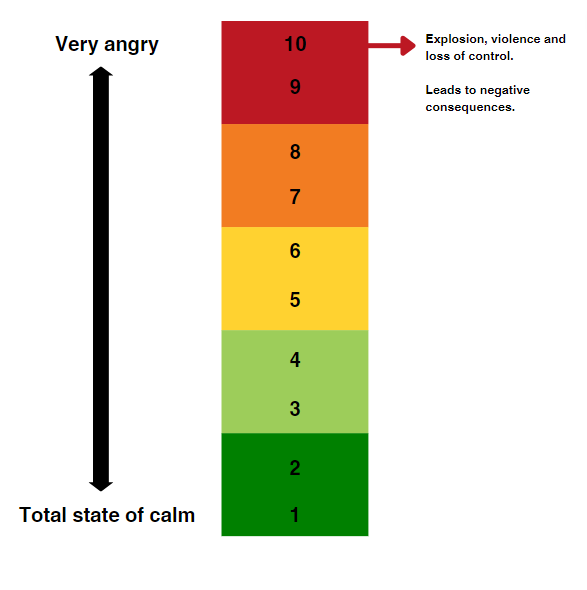
Anger meter 

One technique that’s helpful in increasing the awareness of anger is learning to monitor it. A simple way to monitor anger is to use the anger meter. A score of 1 on the anger meter represents a complete lack of anger or a total state of calm, whereas a 10 represents a very angry and explosive loss of control that leads to negative consequences. Points between 1 and 10 represent feelings of anger between these extremes. 

The anger meter monitors the escalation of anger as it moves up the scale. For example, when a person encounters an anger-provoking event, they won’t reach a 10 immediately. Although, it may sometimes feel that way. A person’s anger starts at a low number and rapidly moves up the scale. There is always time, provided one has learned effective coping skills to stop anger from escalating to a 10. 

One difficulty people have when learning to use the anger meter is misunderstanding the meaning of a 10. A score of 10 is reserved for instances when an individual suffers (or could suffer) negative consequences. An example is when an individual assaults another person and is arrested by the police. 

A second point to make about the anger meter is that people may interpret the numbers on the scale differently. These differences are acceptable. What may be a 5 for one person may be a 7 for someone else. It is much more important to personalize the anger meter and become comfortable and familiar with your readings of the numbers on the scale. In general, however, a 10 is reserved for instances when someone loses control and suffers (or could suffer) negative consequences. 

Anger management scale

Events that trigger anger 

Certain everyday events can provoke your anger and specific events can touch sensitive areas of your life. Red flags usually refer to long-standing issues that can lead to anger. For instance, some of us may have been slow readers as children and may be sensitive about our reading ability. Although we may read well now as adults, it could still cause us to be sensitive about this issue.  

In addition to events experienced in the here-and-now, you may also recall an event from your past that made you angry. You might remember, for example, how the bus always seemed to be late before you left home for an important appointment. Just thinking about how late this made you in the past can make you angry in the present. Another example may be when you recall a situation involving a family member who betrayed or hurt you in some way. Remembering this situation, or this family member, can raise your number on the anger meter.  

Cues to anger 

Another aspect for monitoring anger is identifying the cues that occur in response to an anger-provoking event. Cues serve as warning signs that you’ve been angry and that your anger is continuing to rise. They can be broken down into four categories: physical, behavioural, emotional and cognitive.  

Physical cues 

Physical cues involve the way our bodies respond when we become angry. For example, our heart rates may increase, we may feel tightness in our chests, or we may feel hot and flushed. Physical cues can warn us when anger is escalating out of control or approaching a 10 on the anger meter. We can learn to identify these cues when they occur, in response to an anger-provoking event. 

Can you identify some of the physical cues that you’ve experienced when you have become angry? 

Behavioural cues 

Behavioural cues involve the behaviours we display when we get angry, which are observed by other people around us. For example, we may clench our fists, pace back and forth, slam a door, or raise our voices. Behavioural responses are the second cue of our anger. As with physical cues, they are warning signs that we may be approaching a 10 on the anger meter. 

What are some of the behavioural cues that you have experienced when you have become angry? 

Emotional cues 

Emotional cues involve other feelings that may occur concurrently with our anger. For example, we may become angry when we feel abandoned, afraid, discounted, disrespected, guilty, humiliated, impatient, insecure, jealous, or rejected. These kinds of feelings are the core or primary feelings that underlie our anger. It’s easy to discount these primary feelings because they often make us feel vulnerable. An important component of anger management is to become aware of, and to recognize, the primary feelings that underlie our anger. In these articles, we’ll view anger as a secondary emotion to these more primary feelings. 

Can you identify some of the primary feelings that you’ve experienced during an episode of anger? 

Cognitive cues 

Cognitive cues refer to the thoughts that occur in response to an anger-provoking event. When people become angry, they may interpret events differently. For example, we may interpret a friend’s comments as criticism, or we may interpret the actions of others as demeaning, humiliating or controlling. Some people refer to these thoughts as ‘self-talk,’ because they resemble a conversation, we’re having with ourselves. 

For people experiencing anger issues, this self-talk is usually very critical and hostile in tone and content. It can reflect beliefs about the way we think the world should be beliefs about people, places and things. 

Closely related to thoughts and self-talk are fantasies and images. We view fantasies and images as other types of cognitive cues that can indicate an escalation of anger. For example, we might fantasize about seeking revenge on a perceived enemy or imagine or visualize our spouse having an affair. When we have these fantasies and images, our anger can escalate even more rapidly. 

Can you think of other examples of cognitive or thought cues? 

Cues to anger: The four cue categories 

  1. Physical: Increased heart rate, tightness in chest, rapid breathing, tenseness in muscles, feeling hot or flushed. 

  1. Behavioural: Pacing, clenching fists, grinding teeth, raising voice, glaring. 

  1. Emotional: Fear, hurt, jealousy, guilt, impatience. 

  1. Cognitive/Thoughts: Hostile self-talk, images of violence or aggression, imagining revenge, remembering past hurts. 

Still need help? 

Anglicare Southern Queensland provide a range of counselling and support services for men who are wanting to create safety, respect and partnership in their current or future relationships. To learn more about our Living Without Violence program or other counselling services, please visit: 

  • Home
  • Domestic violence

Domestic violence


Domestic violence, sometimes called domestic abuse or intimate partner violence, is abusive and violent behaviour used to physically or psychologically dominate or harm another person within a domestic or family relationship.
 

What is domestic violence?

Abuse is very different to conflict.

In common couple conflict, the interactions happen between people with an equal balance of power and control. Common couple conflict can often be resolved in a helpful way.

Domestic Violence: Conflict between equals
Conflict between Equals

However, in an abusive relationship, the conflict that occurs involves one partner having power over the other, and uses it to cause fear and intimidation. One partner feels entitled, privileged and justified, while the other feels diminished, disrespected and intimidated.

Domestic Violence: Conflict between two different powers
Conflict that uses power over the other

Not all domestic violence is physical in nature. Abuse can be emotional, which can encompass verbal, financial, social and psychological abuse. Emotional abuse can have just as strong and long-lasting an impact as physical violence.

Emotional abuse occurs when a person is subjected to certain behaviours or actions that are aimed at preventing or controlling their behaviour with the intent to cause them emotional harm or fear. These behaviours are characterised by their intent to manipulate, control, isolate or intimidate the person they’re aimed at. They are generally repeated behaviours and include psychological, social, economic and verbal abuse.

Domestic Violence: Image of father shouting at mother and son in the kitchen

Domestic violence statistics

In 2012 the Australian Bureau of Statistics conducted a Personal Safety Survey that collected information about the nature and extent of violence experienced by men and women since the age of 15, including their experience of violence in the 12 months prior to the survey. 17,050 men and women took part. This survey sheds some light on the prevalence and impact of domestic violence in Australia.

Physical and sexual violence

An estimated 17% of all women and 5.3% of all men had experienced physical or sexual violence by a partner since the age of 15. That’s nearly one in six women, and nearly one in twenty men.

Emotional abuse

An estimated 25% of all women and 14% of all men had experienced emotional abuse by a partner since the age of 15. That’s one in four women, and around one in seven men.

Of the men, 46% experienced anxiety or fear due to the emotional abuse. 76% of the women experienced anxiety or fear.

What is emotional abuse?

For the above research, a person was considered to have experienced emotional abuse where they had been subjected to one or more of the following behaviours. These behaviours were repeated with the intent to prevent or control their behaviour and were intended to cause them emotional harm or fear.

  • Stopped or tried to stop them from contacting family, friends or community.
  • Stopped or tried to stop them from using the telephone, internet or family car.
  • Monitored their whereabouts (e.g.. constant phone calls).
  • Controlled or tried to control where they went or who they saw.
  • Stopped or tried to stop them knowing about or having access to household money.
  • Stopped or tried to stop them from working or earning money.
  • Stopped or tried to stop them from studying.
  • Deprived them of basic needs such as food, shelter, sleep or assistive aids.
  • Damaged, destroyed or stole any of their property.
  • Constantly insulted them to make them feel ashamed, belittled or humiliated.
  • Lied to their children with the intent of turning them against them.
  • Lied to other family members or friends with the intent of turning them against them.
  • Threatened to take their children away from them.
  • Threatened to harm their children.
  • Threatened to harm other family members or friends.
  • Threatened to harm any of their pets.
  • Harmed any of their pets.
  • Threatened or tried to commit suicide.

Seeking advice or support

For both current and previous partner violence, men were less likely than women to seek advice or support about the violence. 70% of men and 39% of women had never sought advice or support about the violence by their current partner.

The impact on children

Of the men and women who had experienced violence in their relationships in the past and had children in their care at the time, 34% of the men and 48% of the women stated that their children had seen or heard the violence.

Changes in prevalence of violence over time

Between 2005 and 2012 there was no statistically significant change in the proportion of women and men who reported experiencing partner violence in the 12 months prior to the survey.

Conclusions

Both women and men experience violence – physical and emotional – in their relationships. The idea that men do not experience abuse or violence is simply not true.

However, it’s quite clear that women are more likely to experience physical or sexual violence and emotional abuse than men.

Furthermore, women are more likely to experience fear or anxiety as a result of their emotional abuse. Of the men who experienced this kind of abuse, less than half felt anxious or afraid about it. This speaks a lot about the levels of power and control men typically have in abusive relationships compared to women.

One troubling finding is that men are less likely to report the abuse or to seek help for it. It’s clear that men face more barriers to seeking help than women. This could be due to the lack of availability of services for men, gendered attitudes commonly held about abuse, or both.

That so many children are witnessing the abuse of their parent is also worrying and can have long term effects on a child’s wellbeing.

Finally, over the past seven years, there’s been no change in the prevalence of domestic violence in Australia. It would seem that this is a wide-reaching social issue that needs preventative measures, such as education on healthy and respectful relationships, positive role models and a systemic approach.

If you need help

If you are in an abusive or violent relationship, please know you are not alone. Support is available.

DVConnect (http://www.dvconnect.org) runs two 24/7 domestic violence hotlines, Womensline on 1800 811 811 and Mensline on 1800 600 636. They provide support and can link you in with services if you’re experiencing crisis.

1800RESPECT offers a telephone support line for domestic violence and sexual assault, and also does online counselling:  https://www.1800respect.org.au/telephone-and-online-counselling

Men’s Line (1300 789 978) is a 24/7 telephone and online support service for men in Australia: https://www.mensline.org.au

Finally please check out the services listed on http://dvconnect.org

Remember if you are at any immediate risk, please do not hesitate to call 000.

Sources

  • Home
  • Domestic and Family Violence Prevention Month

Domestic and Family Violence Prevention Month

May is Domestic and Family Violence Prevention Month. It’s a time where communities raise awareness of domestic and family violence, including coercive control. 

Anglicare Southern Queensland takes domestic and family violence very seriously. For years, we have been advocating for victims and their families. We are also supporting those who have been and are currently impacted by this issue. 

Some statistics on domestic and family violence (DFV)

Statistics emerge each year, highlighting the impact that domestic and family violence has on communities, nationally. Recent data shows that women are “overwhelmingly the victims of violence in intimate relationships…” and continue to be more likely to experience serious harm because of DFV in Australia. In fact, they’re around six times more likely to be hospitalised and four times more likely to be murdered by an intimate partner in a DFV relationship. 

According to data from the Australian Bureau of Statistics and an NCAS report into DFV, since the age of 15, one in six women have experienced physical and/or sexual violence from a partner. Also, one in five women have experience sexual violence from a partner. 

In contrast to these statistics, one in sixteen men have experienced physical and/or sexual violence from a partner and as for sexual violence, one in twenty-one men have experienced this form of abuse. 

Emotional abuse is a more prevalent form of exploitation. It’s believed that one in four women and one in six men have experienced emotional abuse from a partner. 

Below are some other notable statistics relating to victims of DFV in Australia. 

  • One woman is killed, on average, each week by a current or former partner; 
  • Indigenous people are 32 times more likely to be hospitalised from domestic abuse; and 
  • Male victims of DFV are often victims of male perpetrators. 

Facts about domestic violence

There are many misconceptions surrounding domestic and family violence. Unfortunately, these misconceptions can lead to a culture of victim blaming and justification of perpetration towards female victims.  

One of the biggest misunderstandings is that victims provoke their perpetrator. This is a harmful and inaccurate representation of victims. In fact, studies show victims do everything in their power to appease their perpetrator, in hopes that they will not be attacked.   

People also believe that the female victims of DFV would just leave their abuser, if they were in any real danger. Though, unfortunately, some women choose to stay because they are at a higher risk of experiencing extreme danger (including death) if they leave their abuser.  

There are many forms of DFV. It doesn’t always manifest itself as physical abuse. In fact, DFV includes acts of sexual, emotional, verbal, economic, neglect, and elder abuse. It can also include physical, sexual, and emotional abuse towards children.   

Coercive control is another form of domestic abuse which is becoming more understood by communities.  

Victim with bruised eye after experiencing domestic and family violence

Facts about coercive control

The NCAS Summary Report defines coercive control as “a pattern of behaviours used to manipulate, intimidate, isolate and control a partner and create an uneven power dynamic in the relationship.”   

Abusers may use coercive control to isolate their partner from friends and family. They may also monitor the physical movements and online activities of their partner.   

Coercive control can include tactics to restrict the freedoms and independence of victims, including limiting their financial capabilities. It may also manifest itself as jealous and possessive behaviours. An abuser may also use coercive control to threaten or intimidate their partner.  

What is Anglicare Southern Queensland doing about the issue?

Our organisation provides an extensive range of counselling and support programs to encourage perpetrators to change their behaviours. Additionally, we provide support to victims and their families.  

Living Without Violence

Our Living Without Violence program is designed for male perpetrators of DFV. In this service, we offer the 18-week Disrupting Family Violence group program (HMA, 2018) (or we can provide individual counselling if group is not suitable) to men who have used violence and abuse against their partners or children.   

The Living Without Violence program assists men to cease their abusive and violent behaviours. In addition to this, the goal is to help them establish safety, respect, and equal partnership in their relationships and move closer to family wellbeing.  

Specialised Family Violence Service

Anglicare Southern Queensland also offers a service that is designed to support children living in abusive households and their families. The Specialised Family Violence Service is designed with a child-focussed framework.  

Mother consoling her young daughter after witnessing domestic and family violence

In this service, we offer children’s counselling, family counselling and individual counselling to victims/survivors of DFV. We also provide education to those who’ve abused or been violent towards their family members.   

Ultimately, our Specialised Family Violence Service aims to provide individualised support to victims and their children, who’ve experienced or witnessed domestic abuse and violence.  

In summary and for additional support

As mentioned, 39 per cent of people who required support from a specialised homeless service in 2021 and 2022 had experienced DFV.  

Each year, we support an increasing number of women fleeing violent and abusive relationships. Moreover, providing them with safety and accommodation as well as support to secure longer-term accommodation, skills training, and parenting support (if they are fleeing their offender with children).   

Our counsellors and support staff will work with individuals to best identify their needs. We work with women who become homeless (whether it’s due to fleeing an abusive relationship or not) to rebuild their self-worth and make sustainable choices for themselves and their families.  

Click on the links to learn more from our videos explaining DFV and Coercive Control. 

  • Home
  • Queensland Governor visits Thread Together Clothing Hub

Queensland Governor visits Thread Together Clothing Hub

The Queensland Governor, Her Excellency the Honorable Dr Jeannette Young AC PSM visited the Thread Together clothing hub at Indooroopilly on 20 February 2023, coinciding with the second anniversary of the unique clothing service in Queensland. 

Clothing hub partnership

The partnership between national not-for-profit Thread Together, Anglicare Southern Queensland and St Andrew’s Anglican Parish redirects brand new clothing from landfill to people in need. 

Anglicare Southern Queensland Chief Executive Officer (CEO), Mrs Sue Cooke, said that Thread Together provided more than 5,500 vulnerable Queenslanders with new clothing since its establishment in 2021 to 2023. 

“The service initially commenced in Queensland in 2021 with a ‘mobile wardrobe’ sponsored by Bendon Lingerie. The van delivers clothing to those in need through Anglicare and other service providers,” Mrs Cooke said. 

“Last year we were thrilled that The Honourable Dame Quentin Bryce AD CVO, former Governor of Queensland and former Governor-General of Australia, was able to join us to open our permanent clothing hub in Indooroopilly, to complement the van service.” 

“We’re now honoured to host Her Excellency The Honourable Dr Jeannette Young AC PSM at the clothing hub to meet with our wonderful volunteers, workers and customers.” 

More than 2,200 clothes saved

Nationally, Thread Together and its community partners have saved more than 2,200 tonnes of new clothing from landfill over since 2013. In 2022 alone, as a result of the Queensland and NSW floods, the initiative helped hundreds of people and saved approximately 600 tonnes of clothing from landfill. 

Thread Together CEO Anthony Chesler also said that the service is a global-first. Furthermore, it’s taking excess new clothing from manufacturers and designers and redistributing it to those in need. 

“Thread Together is operational in Queensland, New South Wales, Victoria, South Australia, and Hobart. In addition to hubs and mobile services, Thread Together announced the ‘wardrobe project’, a national program designed to assist women and children fleeing domestic violence situations, with the installation of 100 wardrobes into women’s shelters across the nation, with five so far located in Queensland,” Mr Chesler said. 

“The Thread Together Wardrobe and Capsule Service will allow women and children to access clean, new clothing including underwear, socks, sleepwear, and tracksuits, when they arrive at a shelter following a domestic violence situation.” 

Learn more about our advocacy projects 

Anglicare Southern Queensland participates in a range of advocacy projects for individuals, groups and communities across the regions we serve. To learn more about them, please visit the advocacy page on our website 

The Rev’d Sue Grimmett with Thread Together CEO Anthony Chesler, Her Excellency The Honourable Dr Jeannette Young AC PSM and Anglicare Southern Queensland’s Chief Executive Officer Sue Cooke with the Thread Together mobile wardrobe van

The Rev’d Sue Grimmett with Thread Together CEO Anthony Chesler, Her Excellency The Honourable Dr Jeannette Young AC PSM and Anglicare Southern Queensland’s Chief Executive Officer Sue Cooke with the Thread Together mobile wardrobe van